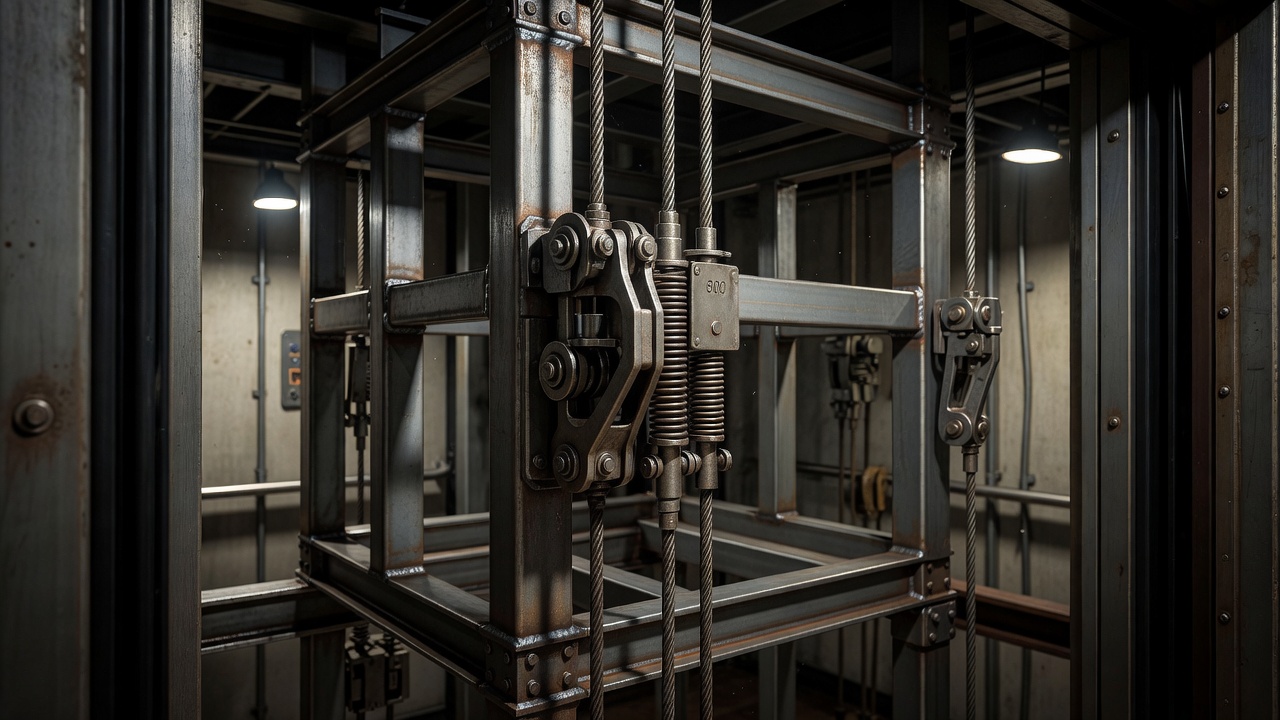
The public perception of elevator failure is heavily skewed by cinematic dramatization. The reality is that modern commercial elevators are governed by strict codes (such as ASME A17.1 in North America and EN 81 in Europe) that require multiple redundant mechanical and electronic safety systems. In the event of a catastrophic failure, such as the snapping of suspension ropes, an elevator is engineered not to plummet, but to lock firmly into place.
The Overspeed Governor and Safety Catches
The most critical fail-safe mechanism in a traction elevator is the governor. Invented in the 19th century by Elisha Otis, this purely mechanical system operates entirely independent of the electrical grid or the elevator's main motors.
The governor is a heavy centrifugal flywheel located in the machine room, connected to the elevator cab via a separate steel cable. As the cab moves, the governor spins. If the cab exceeds its rated speed by a specific margin (usually 15% to 25%), the centrifugal force pushes heavy flyweights outward. These weights catch onto ratchets, stopping the governor wheel and yanking the governor cable.
This forceful pull engages the "safeties"—wedge-shaped metal blocks mounted beneath the cab chassis. The pull forces the wedges upward into the space between the cab and the steel guide rails bolted to the building walls. As the cab attempts to fall, the friction jams the wedges tighter and tighter until the cab grinds to a complete, permanent stop.
Door Interlock Systems
The vast majority of elevator-related injuries do not occur from free-falls, but from door-related incidents and open hoistways. To prevent this, every floor landing is equipped with an electro-mechanical interlock.
The interlock circuit acts as a continuous loop of electricity. The elevator controller can only supply power to the drive motor if this circuit is completely closed. The circuit is physically broken anytime a hallway door is open. Therefore, if a door is pried open on floor 3, the elevator will instantly emergency-stop, no matter where it is in the shaft. Furthermore, the hallway doors have no internal motor; they are purely mechanical and can only be unlocked and pulled open by the clutch mechanism attached to the elevator cab when it has safely arrived at the landing.
Terminal Buffers
In the highly unlikely event that the elevator overshoots the bottom floor without the safeties engaging (for instance, a minor control failure rather than a rope snap), the pit at the bottom of the hoistway contains terminal buffers. These are not designed to safely stop a free-falling cab from the top floor. Rather, they are designed to absorb the kinetic energy of a cab striking the bottom at standard operating speed.
- Polyurethane or Spring Buffers: Used for low-speed elevators (under 1.0 m/s).
- Oil Buffers: Used for higher speeds, functioning identically to an automotive shock absorber. The cab strikes a plunger, displacing hydraulic fluid through precision holes to decelerate the cab smoothly.
Firefighter Emergency Operation (FEO)
During a building fire, elevator logic alters completely. Standard operation dictates elevators will return to the ground floor, open their doors, and shut down to prevent passengers from being delivered to a burning floor. This is triggered by building smoke detectors. Firefighters can override this using a universal key (FEO Phase II), turning the elevator into a manual transport vehicle under their direct command.
Summary of Code Requirements
| Component | Function | Test Frequency |
|---|---|---|
| Governor & Safeties | Prevent overspeed/free-fall | Annual (No load) / 5-Year (Full load) |
| Door Interlocks | Prevent cab movement with doors open | Routine Maintenance |
| Oil Buffers | Absorb terminal impact | Annual inspection |
| Phase I/II FEO | Firefighter override and recall | Monthly operational check |